Sūtak follows visibility, and almost nothing else matters
Every eclipse season the same machinery starts up. A national announcement of sūtak hours. A list of which rāśis are "affected". A market in things to buy before the shadow arrives.
Inside the tradition itself there is a rule that cancels most of it, and it is not obscure or contested: sūtak applies only where the eclipse is visible. An eclipse below your horizon carries none. Not a lighter observance — none at all.
It follows from what the observance is for. Sūtak attaches to seeing the grahaṇa, to the eclipse being in your sky. It does not attach to the fact of an eclipse existing somewhere on a planet of eight billion people, most of whom are on the other side of it at any moment.
And yet the announcements go out nationally, every season, for eclipses that cannot be seen from the country they are announced in.
What that costs, in the plainest terms
Sūtak is a fast. Twelve hours before a solar eclipse, nine before a lunar. In practice it means not eating, often not cooking, not entering a temple, and for many families a day arranged around it.
Done for an eclipse that is genuinely overhead, that is observance. Done for a shadow crossing the South Atlantic while you are asleep in Delhi, it is a day of hunger for nothing — and it falls hardest on exactly the people the tradition itself tried to protect.
The exemptions, which are in the same texts as the rule
Where sūtak genuinely does apply, the dharmaśāstra digests excuse the people it would harm: the ill, the very old, young children, and pregnant and nursing women.
This is not a modern softening or a concession to convenience. It sits beside the rule in the same literature, and it is dropped from popular practice far more often than the rule is. The result is that the fast is kept most strictly by the households least able to afford it.
We print it every time, on the same screen as the timings.
The penumbral eclipse, which is not counted an eclipse
There is a second rule that removes obligation, and it is missed almost as often.
The earth casts two shadows: a dark inner cone, the umbra, and a pale outer one, the penumbra. When the Moon passes only through the outer shadow, that is an upacchāyā — a penumbral eclipse. The Moon dims very slightly. Most people looking directly at it cannot tell that anything is happening at all.
The almanac tradition is settled on this: an upacchāyā eclipse is not counted a grahaṇa, and no sūtak attaches to it. Panchangs print the note every time one occurs. The sites that sell around eclipses do not print it — because an eclipse nobody can see sells nothing.
Two of the next six eclipses are penumbral. This page says so about each of them.
What we compute, and against what
For each coming eclipse: the type, the instant of greatest eclipse, the point on the earth beneath it, and then — for the city you name — whether it is visible at all, first and last contact on your own clock, how much of the disc is covered, and how high the Sun or Moon stands while it happens.
These are checkable numbers, not opinions. The total solar eclipse of 2 August 2027 has its greatest eclipse at 25.49° N, 33.17° E at 10:06:39 UT — which is Luxor, and matches the published circumstances for the best-documented eclipse of the next decade. That check is in our test suite, and it is the reason the rest of the page is worth believing.
The map is not a borrowed atlas. We sample the obscuration across the whole globe with the same engine and paint what falls, so the shape you see is the shadow itself rather than a picture of continents with a shadow drawn on top.
The personal reading, and the sentence that has to go with it
If you give a birth date, time and place, we count which house the eclipse falls in from your natal Moon — the janma rāśi — and name how the almanac tradition groups that house. The 3rd, 6th, 10th and 11th read as favourable; the 1st, 5th, 8th, 9th and 12th read as difficult; the rest are read either way.
"The eclipse falls in your eighth" is the single sentence this entire trade is built on. So we never print it alone.
Beside it goes the arithmetic. We measured the next forty eclipses across all twelve rāśis: an eclipse falls in any given house from your Moon about once every 2.6 years, and the distribution across the twelve is flat. Everybody gets one in their eighth about as often as they get one in their eleventh. Roughly five eclipses happen a year and they move around the whole circle.
A frightening claim with its base rate beside it is a different sentence from the frightening claim alone. That difference is most of what this company is for.
What this page will not do
It will not give a severity score, for a person or for a sign. That number is the engine of the whole eclipse-fear market, and we will not print one. Our test suite reads the executable code of the engine and fails if the word appears in it.
It will not tell you what an eclipse is going to do to you. The texts make statements about eclipses; we quote them and say whose they are. The leap from a statement to "this will happen to you" is the trade's entire business and it is not ours.
And there is no remedy here. No donation, no mantra, no stone, nothing to buy before the shadow and nothing to buy after it. Your birth details are used to find one number and are then gone.
Where the rules come from
The sūtak periods — twelve hours before a solar eclipse, nine before a lunar, four and three prahar — are the figures in general use across the Indian almanac tradition. Some regional practice differs, and a few authorities reckon from sunrise rather than by the clock. We say whose reckoning we are using rather than presenting one as the only possible answer.
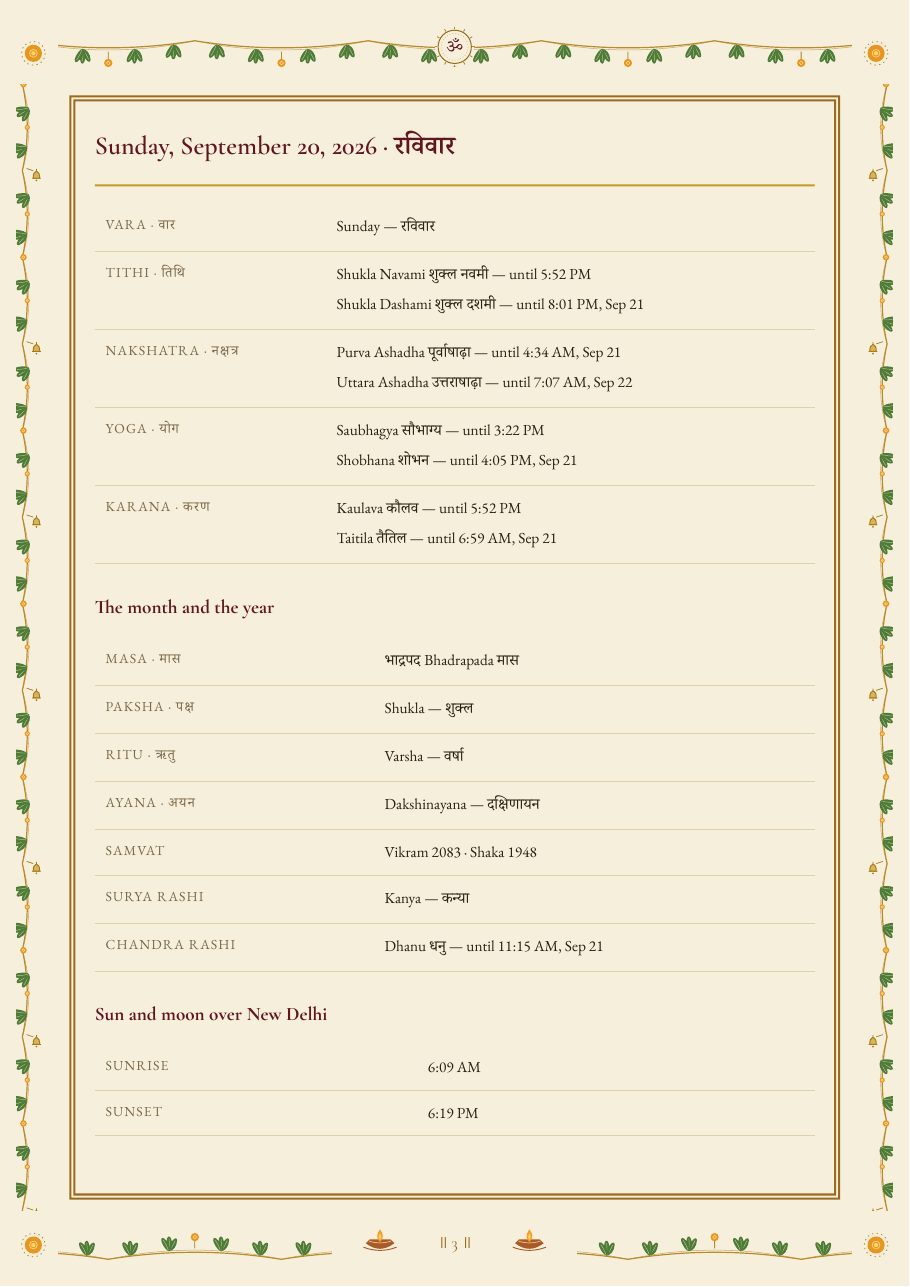
Positions are sidereal longitudes from the Swiss Ephemeris with the Lahiri ayanamsa. Eclipse circumstances are computed when you load the page — not copied from a table someone typed out once, which is how the wrong sūtak times get repeated for years.
If you take one thing from this page
Before you fast, check whether the eclipse is above your horizon. Most of the time it is not, and then the tradition asks nothing of you at all.
Questions
How many hours before does sūtak begin?
Twelve hours for a solar eclipse, nine for a lunar — four and three prahar, as the digests put it. Both end at mokṣa, the last contact, not at mid-eclipse. We count from the contacts in your city rather than the global ones, which is why two cities come out different.
My panchang says a different time — which is right?
Usually both, for different questions. Many announcements are made for one city, or counted from the global contacts. This page computes for the city you name and shows whether the eclipse is visible there at all, so you can see where the difference comes from.
Is this the same engine as the panchang?
The same. Swiss Ephemeris, sidereal, Lahiri ayanamsa. The eclipse circumstances are computed when you load the page, not looked up in a table.