What Mangal Dosha actually is
Mangal Dosha — also called Kuja Dosha, or simply being Manglik — is not a curse and it is not a diagnosis. It is a position: Mars sitting in certain houses of a birth chart. The classical tradition treats it as a serious question at the point of marriage, and it is probably the single most common reason a chart gets opened at all.
The verse quoted everywhere names five houses:
लग्ने व्यये च पाताले जामित्रे चाष्टमे कुजे ।
कन्या भर्तुर्विनाशाय भर्तुः कन्या विनश्यति ॥lagne vyaye ca pātāle jāmitre cāṣṭame kuje — Mars in the 1st, the 12th, the 4th, the 7th, the 8th.
This verse turns up across the manuals and is usually attributed to Jataka Parijata; some editions carry it inside muhurta compendia instead. We name the verse and say plainly that its home varies between editions — because the alternative is to invent a chapter number and sound more certain than the tradition actually is. That habit is why so many astrology pages read as authoritative and cannot be checked.
Where the traditions part company — and why your answer may depend on it
This is where it gets interesting, and it is the part almost every calculator hides.
- The northern reckoning uses those five houses: 1, 4, 7, 8, 12.
- The southern reckoning adds the 2nd — kutumba, the family a marriage joins — giving six: 1, 2, 4, 7, 8, 12.
If your Mars is in the 2nd, that single undeclared choice is the whole answer — and you were never told a choice was being made. One astrologer says Manglik, another says not, and both are correct inside their own tradition. This calculator computes both and says so out loud when they differ. A verdict you cannot trace back to a rule is not information; it is a mood.
Counted from three places, not one
Mars is not judged from the ascendant alone. The classical method counts it from three reference points, and counting all three changes the answer often:
- From the Lagna — the body and temperament the marriage has to live with.
- From the Chandra Lagna, the Moon — the mind. Most of the matching apparatus rests on the Moon, so missing this one is not a small omission.
- From Venus — the karaka of marriage. A chart that is clean from the Lagna can be afflicted from Venus, and a family's own astrologer will check that next.
Counting from one reference is the common shortcut, and it changes the answer. The result above shows all three, whether or not any of them fires.
What each house is said to touch
The houses are not arbitrary. Each one is about a part of a marriage, and Mars's nature — heat, speed, confrontation — is said to land on that part.
- 1st (Lagna) — the body and the temperament. A fast-moving personality that collides easily.
- 2nd (Kutumba) — the family, and the speech inside it. The disputed house; southern reckoning only.
- 4th (Sukha) — the home, and peace within four walls.
- 7th (Kalatra) — the spouse and the partnership itself. This is the house the whole question hangs on.
- 8th (Ayus) — longevity, and what is held in common but not spoken.
- 12th (Vyaya) — the bed, expenditure, and what is given away.
The cancellations — Manglik Bhanga
This is the half most free calculators leave out, and it is the half that matters most. The tradition that names the affliction also names the conditions that lift it. An answer that reports the dosha without checking the cancellations is half a fact — and half a fact about a marriage is worse than none.
- Mars in its own sign — Aries or Scorpio. A planet at home is not restless, and the affliction is held to be its restlessness.
- Mars exalted — in Capricorn. Exalted Mars is disciplined rather than merely forceful.
- Mars in Leo or Aquarius — the signs of the Sun and of Saturn. Commonly given in the manuals. We flag it as the least well-attested of the sign exemptions rather than presenting it at equal weight with the others.
- Jupiter joining or aspecting Mars — Guru with Mars, or throwing its 5th, 7th or 9th glance onto it. This is the most consistently given cancellation across the manuals. Note the direction: the aspect is counted from Jupiter, not towards it. Getting that subtraction backwards is a common error and it silently changes the answer about a third of the time — the 7th aspect is symmetric, so the mistake looks correct whenever that is the one in play.
- Mars dignified in the very house it afflicts — Mars in the 1st in Aries, the 4th in Scorpio, and so on: the placement form of the exemption rather than the sign alone.
- Venus joined with Mars — given for marriage specifically, Shukra being the karaka. Less universally accepted than the Jupiter rule.
Saturn's contact with Mars is computed and shown, and deliberately not scored. The manuals read it both ways — as a restraint on Mars, and as two malefics compounding. Quietly picking a side would be exactly the thing this project does not do.
One cancellation cannot come from a single chart at all: if both partners are Manglik, the tradition holds that it cancels for the pair. That needs two charts, not one, which is why it lives in our compatibility report rather than on this page.
A worked example, computed rather than described
Generic paragraphs are easy to write. Here is a real chart, run through this same engine: 27 April 1990, 14:05, Delhi — the date our own form shows as its example. Every number below came out of the computation.
- Ascendant Leo. Mars at Aquarius 11°05′ — the 7th house from the Lagna.
- Moon in Taurus. Counted from the Moon, Mars lands in the 10th — not a dosha house.
- Venus at Aquarius 28°43′. Counted from Venus, Mars is in the 1st — a dosha house again.
So the dosha forms from two of the three references — the Lagna and Venus — and it forms under both reckonings, because the 7th and the 1st are in both lists. A calculator that looked only at the Lagna would have stopped at half of that.
Now the cancellations. Three apply. Mars is in Aquarius, the Sun-and-Saturn sign exemption. Jupiter, in Gemini, throws its 9th aspect onto Mars — the 9th from Gemini is Aquarius, and you only find that by counting from Jupiter; counting from Mars gives a different sign and misses it entirely. And Venus is sitting with Mars in Aquarius. Saturn is in Capricorn and aspects Mars from nowhere, so the contested Saturn question does not even arise in this chart.
The verdict: Manglik, mitigated. That is exactly the answer that would be badly served by the word "yes" — which is what most free calculators return. Three classical conditions relieve it here, and a family deciding something is entitled to know that.
How the computation is done
This page does not look anything up in a table. Planetary positions come from the Swiss Ephemeris — the same source professional astrology software rests on — and the signs are sidereal, using the Lahiri ayanamsa. For the worked example above that ayanamsa was 23.7219°. If you have seen a different sign for your Mars somewhere else, that is the most likely reason: the other calculation was tropical, or used a different ayanamsa. We wrote a whole article about that disagreement in the Journal.
The birth city is not decoration. The ascendant moves about a sign every two hours, and that clock is local — longitude, time zone, and whatever daylight saving rule was actually in force on that date. Our city resolver computes the offset for that date rather than reading a fixed table, so a year with an unusual DST rule still gets the right ascendant.
Houses are counted whole-sign, which is the traditional jyotisha method and the one these verses were written for. Every answer prints the ayanamsa, the coordinates and the UTC offset it used underneath it, so anyone who wants to check the arithmetic can.
What we deliberately do not compute
Every answer carries this list with it, and that list is the product. A calculator that admits what it left out is a different kind of object from one that does not.
- "The dosha lapses after 28." Very widely repeated; we can find no classical text to point at. So it is not applied.
- Remedies. No pujas, no stones, no kumbh vivah. This tells you what your chart says, not what to buy. We do not manufacture a fear and then sell relief from it.
- Any prediction about a marriage. The verse is severe in its language. A computed placement is not a verdict on a life.
What to do with the answer
If this page says the dosha is present, that is what a computation can say and no more. People who have used this shastra for generations have read it as a caution rather than a sentence. The useful question is not "am I Manglik" but: from which reference, in which tradition, and what cancels it. You have all three above.
And if it says your chart is clear, take that with the same care. It is the answer to one question, not a reading of a whole chart.
The computation above is the same engine that runs our full Life Kundali — the same Swiss Ephemeris, the same ayanamsa, the same arithmetic. The free answer here cannot disagree with the booklet, because both run the same code. That was a deliberate piece of engineering, not a coincidence: before it, this engine held three different opinions about Mangal Dosha and they did not match each other.
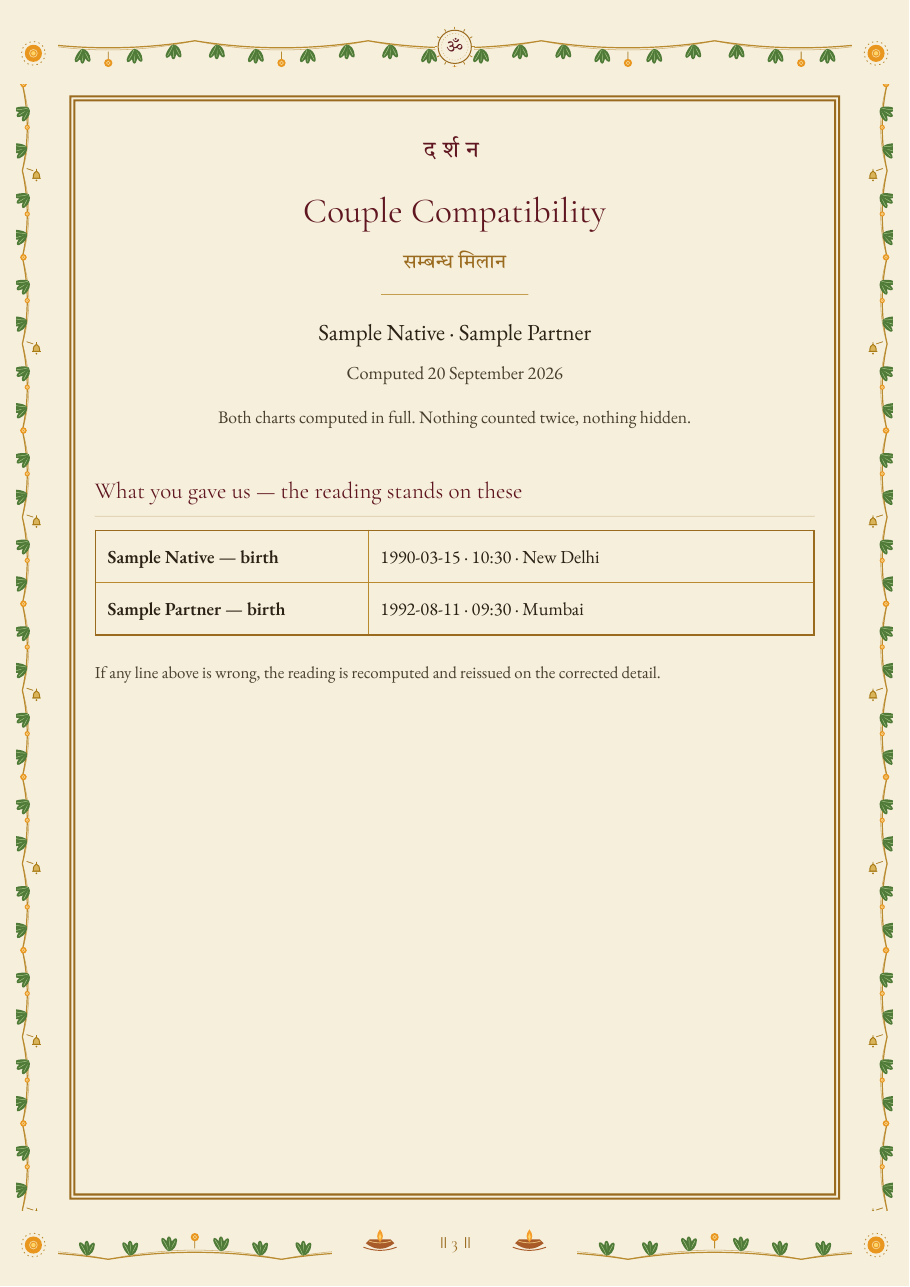
See the full Life Kundali Couple compatibility — both charts
Common questions
Does being Manglik mean I must marry another Manglik?
The tradition does hold that when both charts carry the same affliction it cancels for the pair — and that is the rule most often skipped, because checking it means opening the other person's chart too. But it is a cancellation, not an instruction.
I do not know my exact birth time. Then what?
The ascendant changes roughly every two hours, so the answer counted from the Lagna is time-sensitive. The answers counted from the Moon and from Venus are far more forgiving — neither usually changes sign across a whole day. If your time is uncertain, lean on those two of the three above and treat the Lagna line as provisional.
Do you keep my birth details?
No. This is a read: the details come in for the computation and are dropped when the answer goes back. No account, no email, and no order line is written anywhere. That is why there is no consent checkbox on the form — there is nothing to consent to.
I got a different answer somewhere else. Which is right?
Four reasons are common, and all four are real. One: the other calculator counted from the Lagna only and skipped the Moon and Venus. Two: it silently picked a tradition about the 2nd house. Three: it never checked the cancellations. Four: it used tropical signs or a different ayanamsa, which moves Mars's sign outright. The answer above leaves every one of those steps visible, so you can see for yourself where the two parted company.
Is this the same computation that goes into your paid booklet?
Yes, literally. The booklet's yoga list, the compatibility report's Manglik table and this page all run the same code. That was not true before: the engine held three different opinions about Mangal Dosha and they did not agree, which meant one person could buy two products and be told two different things about one Mars. Fixing that was the precondition for publishing this calculator at all — a free answer that contradicted the paid one would have been worse than no free answer.
Home › Free tools › Mangal Dosha calculator
What the texts say — read on
These pages describe what the tradition says, with its sources. None of them tells you what to do.